No “I” in TEAM.


I am reading the article Individuals Perform Better When Focused on Team. It has a lot of relevance for my children’s soccer games, but it also resonates with our student leadership course and especially for working with my colleagues in student affairs. Try changing your “I” to a “We” today and see what you can accomplish.

By focusing on the team, you include yourself without putting the focus or extra pressure on yourself. ~Deborah Feltz

Presidential Agenda

My university named a new president last week and I was excited to learn that he has goals similar to mine in the area of decreasing student debt. This is a topic that is of great interest for me as I counsel first-generation college students, many of whom borrow large amounts of money through federal, institutional and private sources to meet expenses. As we reside in a state where 85 percent of the state’s need-based grants support students enrolled in private, not-for-profit colleges with only 6 percent supporting students enrolled in public colleges and universities, change will not be easy

It’s increasingly difficult for the middle class to afford a high-quality public education. That’s a huge concern of mine. Our long-term goal would be that any qualified Iowan could graduate debt free. That’s the direction we want to be going.  ~Steven Leath, president-elect

More on the student debt challenge:

Student Debt: No new car, caviar, four star daydream

Student Debt continued: Still no caviar

Student loans of interest

It’s not only a national debt crisis

Money, money, money… Must be funny…

Money, money, money… Must be funny…

In the 2009 fiscal year, the default rate on student loans climbed from 7 percent to 8.8 percent, over the previous fiscal year, according to a U.S. Department of Education report released today.

Of the 3.6 million student-loan borrowers whose first repayment period was between October 1, 2008, and September 30, 2009, about 320,000 people defaulted before September 30, 2010.

You can review information on the national student loan default rate and rates for individual schools, states, and types of institutions at the Federal Student Aid Data Center.

A Parent in Student Affairs

This post was shared on The Student Affairs Collaborative as a series of reflections on the tenth anniversary of September 11, 2001.

September 11, 2001 was a beautiful day in the middle of the country with skies so blue it hurt your eyes. A student stopped by our office suite early that morning and mentioned a plane crash in New York City. We pulled out a small television we kept in the office to see what news we could find. As it turned out, that 4-inch Sony was the only TV in our building that day. Many of my colleagues spent hours gathered around my desk as we attempted to make sense of what was occurring.

I watched Katie Couric speaking with NBC Pentagon correspondent, Jim Miklaszewski, when he paused and then said a large explosion had just rocked the Pentagon. It was 9:37 EDT. Karen Kincaid died in that crash of American Airlines Flight 77. She graduated from my high school a few years before me. Everyone who met Karen said she was the nicest person they ever knew.

My husband worked on campus and we were in constant phone contact sharing online information. U.S. news sites were bogged down with web traffic, so we found most of our information from the BBC website. I called my parents in Colorado. It was still early there, so my dad was a bit foggy when answering the phone. It took a bit to convince him to turn on the television. When I reached my sister, she shared that my brother-in-law was currently on a flight to Denver. It was several hours before we could confirm his arrival. His return flight became a fight for the last available rental car and a long drive home.

I kept busy checking on students on internship or exchange along the east coast. One student was interning with a firm just 25 blocks from the World Trade Center and had been at a meeting only 6 blocks away at the time of attacks. Another student, like Valerie, was enrolled at William Paterson with a clear view of the Twin Towers as they collapsed.  A third, enrolled at another campus in New Jersey, canceled exchange, packed her car and returned home within a day.

Although not much work was completed, we remained at the office through the day. Around 4:00 p.m., word began circulating that there was a gasoline shortage in town. My husband and I decided to head out a bit early to pick up our 2 ½ year old daughter from her childcare, just a mile west of campus. As we approached the main thoroughfare though town, traffic was at a stand still in all directions. Cars filled every intersection. We backtracked and cut through parking lots, seeking an open street. After several blocks of thwarted attempts, my panic level was reaching epic proportions. We could not cross the highway.

I had worked all day to make certain my students were present and accounted for. It never occurred to me that I would not be able to get to my own child a mile away.  And there it was, that work/life balance that so frequently challenges us in student affairs, smacking me in the face. Yet this time, it was accompanied by fear like I had never felt. A fear so strong I can feel it now; the fear that I could not protect my child.

Of course we eventually navigated around town, and within a few days, life returned to something resembling normal in our university community. But we knew that every other person in the country was to trying to make sense of it, just like we were.

Campus Speaker: Instant Communication

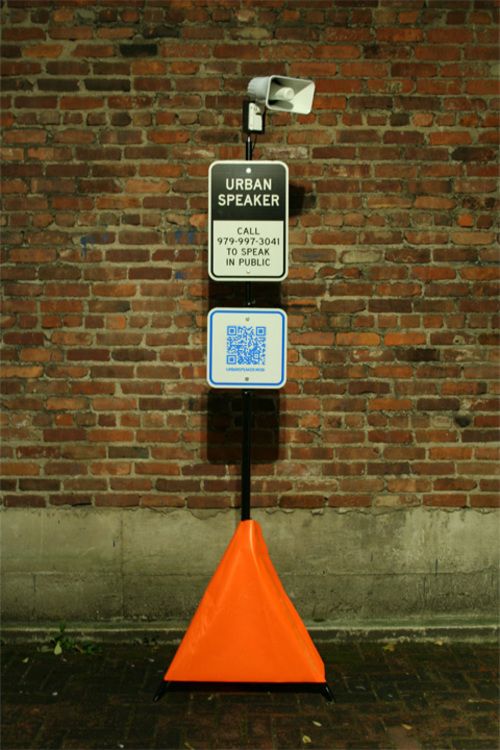
Tom Krieglstein shared a blog post last week featuring this Urban Speaker, an outdoor art installation by Carlos J. Gomez de Llarena.  It was intended to offer an instant stage for public communication.

I shared with a colleague that having my own urban speaker, or Campus Speaker, would be quite handy as my office overlooks a major residence hall thoroughfare.

Things I would share on my Campus Speaker:

Hey, you! Walking through the landscaping! They call it a sideWALK for a reason!

Hey, you! Please use the crosswalk! You are becoming a retention risk!

Yo! You on the motorcycle! SLOW DOWN! This is a residential area!

And today I could add things like, “Congrats to the Cyclone Volleyball team for sweeping Iowa in three sets!”

What would you share on your Campus Speaker?

It’s not only a national debt crisis

Helping students understand how to effectively manage student loan debt is a bit of a project for me. I spend much of my professional work counseling first-generation college students, most of whom have high financial need. I have shared my views on the student debt crisis here, here, and here.

Andrew Hacker and Claudia Dreifus present some excellent alternative plans for lowering student costs in higher education by encouraging students to choose community colleges and state institutions.  And although I disagree with their portrayal of unscrupulous financial aid officers when describing the individuals at my own institution, I do not doubt that they are out there.

The next subprime crisis will come from defaults on student debts, starting with for-profit colleges and rising to the Ivy League. The parallels with housing are striking. In both, the written warnings aren’t understood, especially on penalties and interest rates. And in both, it’s assumed that what’s being bought will rise in value, in one case the real estate, in the other the salaries which will accrue with a degree. One bubble has burst; the second is already losing air.

Treating students like an ATM machine

Inside Higher Ed posted another feature on the prospect of eliminating subsidized student loans and their relation to the federal deficit. Is there sense in using students seeking higher education as a revenue generating source for the federal government? Shouldn’t we all strongly object to shifting funds from student aid toward deficit reduction?

The federal government is making a lot of money on students and on parents. There’s a risk of almost treating students like an ATM machine.  ~Becky Timmons, assistant vice president for government relations, American Council on Education

Student loans of interest

Helping students be aware of the impact of student loan borrowing to finance college is a bit of a pet project of mine and I have written about it here and here.  Don’t get me wrong, I think a moderate investment in student loan to obtain higher education is a very wise investment. Moderate being the key word in that statement.

Inside Higher Ed profiled a proposal made during recent Congressional discussion on the federal deficit that would require students to pay the interest on student loans while they’re enrolled in college, a change that would save the government $40 billion over 10 years.

Students who borrow the maximum amount of subsidized loans, $23,000, and take six years to graduate would owe $5,000 more by graduation and $9,000 after a 20-year repayment period.  ~Pauline Abernathy, Institute for College Access and Success.

National Association of Student Financial Aid Administrators president Justin Draeger said he strongly objected to the idea of shifting funds from student aid toward deficit reduction but finds it a better alternative than cutting the Pell Grant which would have more impact on student access to college.

When debt attributed to private and federal student loans is set to surpass $1 trillion dollars in the United States and already contributes to the ballooning national debt, isn’t adding $5,000 more debt to the average student loan borrower government-speak for robbing Peter to pay Paul?

Shouldn’t we all strongly object to shifting funds from student aid toward deficit reduction?

Future Earnings, Redux

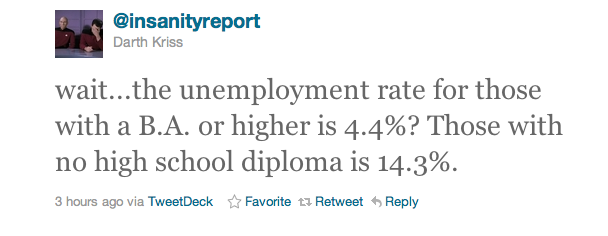
The monthly jobs report was released this morning, It showed that even in our current tough economy, lo and behold, unemployment for those with a college education is considerably below the national averages. Go figure.