College Students & Money: No new car, caviar, four star daydream

It’s handy having a international expert on financial literacy around when counseling first-year college students about managing their resources. Iowa State professor Tahira Hira is recognized for her work on consumer spending including debt and bankruptcy. As our graduates leave campus with some of the highest student loan debt in the nation, I feel an obligation to discuss personal finance during our first-year seminar.


Dr. Hira’s three main principles for college student financial well being:
  • Live within your means.
  • Spend less that you make.
  • Be mindful of borrowing, including consumer credit or students loans.
Spending plans are key to managing finances and Hira shares these tips for students:
  • Give yourself an allowance that fits your budget.
  • Balance your checkbook regularly.
  • Leave your credit cards at home to avoid impulse buying.
  • When going out for an evening, take only as much cash as you can afford with you.
  • Eliminate casual shopping.
  • Reduce stress with exercise, hobbies, or community service; versus shopping.
Our financial aid office partners with a great online tool called CashCourse that offers financial planning tools and economic tips. I utilize CashCourse for a personal finance assignment in our seminar course.

Higher Education Dialogue on Race

A conference on race and ethnicity has become a hallmark program at our midwest research university. For the past decade, the Iowa State Conference and Race Ethnicity, or ISCORE project, has been our flagship program on all things affecting diversity, inclusion, and persons of color in higher education. Based upon the National Conference on Race and Ethnicity in Higher Education (NCORE), ISCORE celebrated it’s 10th anniversary in March. It has become a model program for other campus CORE programs. I wrote here about about this year’s keynote, Michele Norris.

The Iowa State project sponsors a team of students, staff and faculty to travel and participate at NCORE each summer. Information gathered from that experience is reviewed throughout a fall semester course: Forum on United States Race and Ethnicity. Students then submit individual and group presentation proposals for ISCORE. Hundreds of Iowa State students and staff have been the beneficiary of this project grant. Thousands of students, faculty, staff, and community members have attended the campus conferences. Through lean financial times in higher education, ISCORE has continued to thrive.

Washington Post columnist and editor, Eugene Robinson, suggested in an MSNBC segment this morning that recent discussion on race in America is good for the country, but we rarely see it happen in the classroom. His comments were in reference to the arrest of an African-American Harvard professor by a white police officer that made national news. Robinson’s column this week highlighted the incident and questioned the still very common racial double standard.

For at least one university, the discussion and dialogue on race and ethnicity is alive and well, and continuing.

What is your campus dialogue on diversity, race and ethnicity?

For many of the great, great successes of the world…

For many of the great, great successes of the world, the background they came from was their great challenge. I’m trying to find those people. Those who may not have the highest grade point or a perfect family background, but who can be successful. These are the ones who will lend the helping hands in the future. ~ Christina Hixson

The Hixson Opportunity Awards began at our university in 1995. Since that time, I have read thousands of scholarship applications, hoping to identify the student who is most deserving and most needs our support. The student who will become that helping hand of the future.

I have instructed our students as they muddled through the first college year. We have spent endless hours counseling students struggling with a class, roommate, finances or the multitude of challenges faced by first-generation college students in the quest for a degree. Most importantly, we have helped to develop leaders and scholars through connections, resources, and occasional 3 a.m. phone calls. Our program focus of community, challenge and support has become a model for retention and graduation success duplicated at other universities.

To celebrate the 10th anniversary of the first Hixson Scholars graduating from Iowa State, my good friend Steve Sullivan revisited many of the students he featured in stories over the years. Our students, and now our alumni, are the backbone of the Hixson Program. Take a peek at his Visions magazine feature.


Facebook is not rocket science?

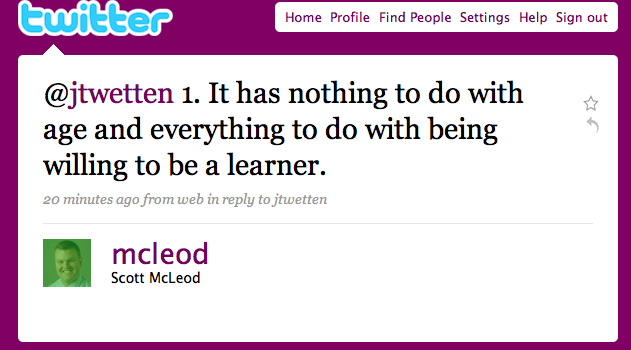
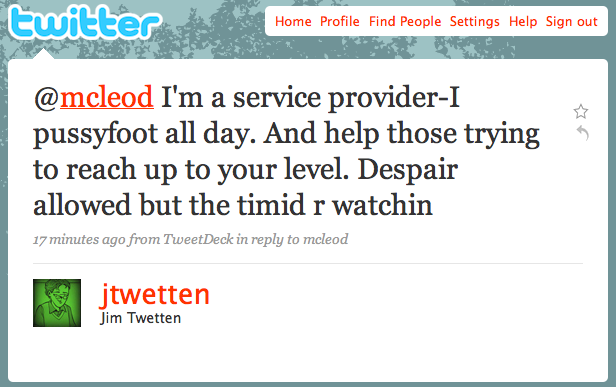
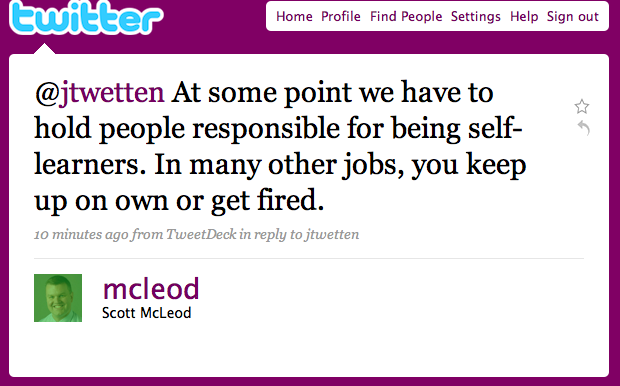
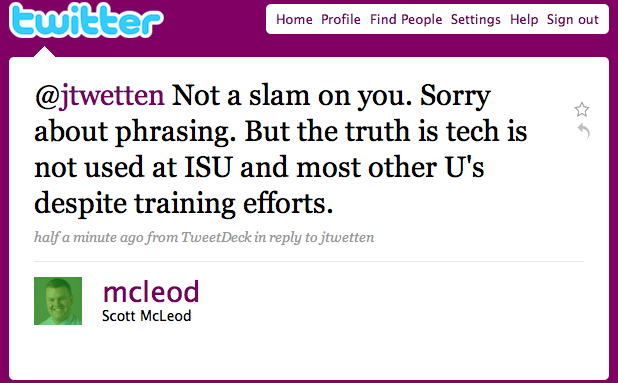
An interesting conversation unfolded on Twitter between two distinguished members of our university. It followed the announcement of a Facebook workshop for faculty and staff that seemed less than timely considering the declining trends of high school and college aged Facebook users, our primary market.


I captured this conversation between a director in the IT academic technology unit and a professor with expertise on K-12 school technology leadership, because it demonstrates the conflict many of us confront when introducing new media and technology in higher education.

[This was a ridiculous blog exercise and there must be an easier way to do this than with screenshots and I am now suffering from carpal tunnel from too much point and click, but I didn’t want to lose such great dialogue!]

What are your thoughts?


Use of abacus and slide rule encouraged

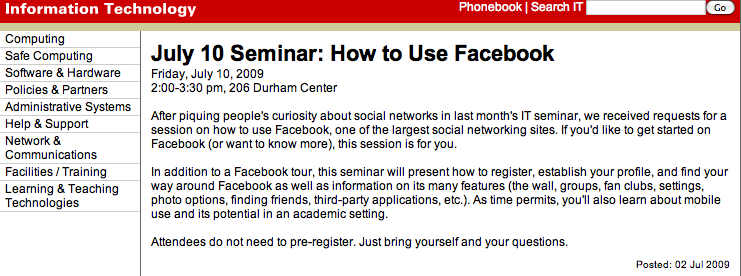
As a reminder that I work for a university of science and technology, the following workshop was announced in a faculty/staff newsletter delivered to campus email accounts this evening.

After piquing people’s curiosity about social networks in last month’s IT seminar, we received requests for a session on how to use Facebook, one of the largest social networking sites. If you’d like to get started on Facebook (or want to know more), this session is for you.

In addition to a Facebook tour, this seminar will present how to register, establish your profile, and find your way around Facebook as well as information on its many features (the wall, groups, fan clubs, settings, photo options, finding friends, third-party applications, etc.). As time permits, you’ll also learn about mobile use and its potential in an academic setting.

Attendees do not need to pre-register. Just bring yourself and your questions.

Dr. Scott McLeod, a professor in our Educational Administration program, summed up my response quite efficiently.


Celebrating Independence

Happy Birthday America! Don your red, white and blue and grab your sparklers (with parental supervision, of course.) Enjoy these quotes on the patriotism of education (plus movie bonus!)

Educate and inform the whole mass of the people… They are the only sure reliance for the preservation of our liberty. ~Thomas Jefferson

Children should be educated and instructed in the principles of freedom. ~John Adams

In less than an hour, aircraft from here will join others from around the world. And you will be launching the largest aerial battle in the history of mankind. “Mankind.” That word should have new meaning for all of us today. We can’t be consumed by our petty differences anymore. We will be united in our common interests. Perhaps it’s fate that today is the Fourth of July, and you will once again be fighting for our freedom… Not from tyranny, oppression, or persecution… but from annihilation. We are fighting for our right to live. To exist. And should we win the day, the Fourth of July will no longer be known as an American holiday, but as the day the world declared in one voice: “We will not go quietly into the night!” We will not vanish without a fight! We’re going to live on! We’re going to survive! Today we celebrate our Independence Day! ~President Thomas Whitmore, Independence Day

Come for fun, stay for love…

The fun thing about being enrolled again as a student at my institution is that you receive all of the specialty student email blasts and announcements from student organizations. Like this one.

SUMMER Speed Date Event
Find your summer love at our next Speed Dating Event! Instant Dating will again be hosting a 3-Minute Dating Event. You will go on up to 50 dates in one night!

Who: All Iowa State students

What: 3-Minute Dating hosted by Instant-Dating

When: Wednesday, July 1st, 2009

Time: Starts at 7pm (you may come late or leave early as needed)

Where: 136 UDCC; First Floor Conference Room in the UDCC (below the dining services, down the hallway from the UDA hall desk)

Admission: $7

How it works: Everyone is assigned a “number-nametag” after signing in. You will then rotate every 3 minutes as you go on ‘mini’blind-dates (It’s like you’re on your very own reality Bachelor or Bachelorette show!). At the end of the event, you can choose the “numbers” of people you would be interested in seeing again on a second date. Then within 48 hours of the event, an email will be sent to you containing all of your mutual matches with their name and email address. Good Luck! (NO pre-registration is required)

Take a break from studying! Come for fun, stay for love…
Sounds like a new theme for our first-year seminar and university retention efforts.
Come for fun, stay for love…

Declining access to higher education?

I am fortunate to administer an endowed scholarship that flourishes even in these financial times thanks to careful foundation oversight and recent gifts from our generous donor. It is a partial tuition scholarship and most students also receive significant institutional and federal aid. So, I have concerns when I read that many scholarship providers are pulling back support.

Full cost of attendance at my university this fall (tuition, fees, room, board, books/supplies, personal expenses) is $18,370. The average financial need (cost of attendance minus expected family contribution) of my new class of 100 scholarship recipients is greater than $15,500. More than half of the students have need within 1% of the full cost of attendance.

With less money thrown off by endowments and contributed by donors, scholarship providers must make difficult choices. Should current scholarship recipients have their awards renewed, at the expense of new applicants? Should scholarship amounts be reduced so that the same number of students can benefit? Should the size of awards be protected, but their number cut? ~Jonathan D. Glater

Access to higher education becomes even more important in challenging economic times. Here’s hoping that scholarship providers can keep their focus on priorities.


…To boldly go where no man has gone before

Okay, so I exaggerate, men and women have gone here before.


Today, I embarked on the adventure of a PhD in Higher Education. Nudged along by my very wise mentor and adviser, Dr. Dan, I began the first class in my program and had an energetic day with an exciting group of professionals in education. Pretty soon I will be able to use univariate, bivariate, and multivariate categorical data in a sentence. And it will be wonderful.


I also got a discount today on my iced mocha at Caribou for being able to name all the original members of the Star Trek cast. If you haven’t seen it yet, make your aerospace engineering students proud and get yourself to a showing of the new Star Trek.

Higher Education Priorities

Just squeaked through crunch time of awarding $1 million private scholarship dollars to students entering our university this fall. The award is equal to one-half tuition and fees for four years. Most of the students receiving this award have significant to full financial need in meeting the cost of attendance for resident students, so getting this envelope in the mail is a reason for celebration.

So why am I not celebrating?

Analysis of financial aid packages for these students show that those with stellar grades who are scrambling for outside scholarships may meet about half of their expenses through grant and gift aid, leaving $8,000 to $10,000 in loan or out-of-pocket expense. Considering that the Iowa median income is $47,000 and most recipients of this award fall below the median, how is a student to afford an education at a Midwest public research university?

Our students graduate with some of the highest student loan debt in the nation and have amassed a 58% increase in loan debt in the last decade. Our state legislature disburses 85% of the state’s $3.4 million of need-based grants to students enrolled in private, not-for-profit colleges reserving only 6% for students enrolled in public colleges and universities.

Slow economic recovery and higher student loan default rates will not improve anytime soon. Tuition freeze? Loan forgiveness? I don’t have all of the answers. But it is time to prioritize the opportunity of higher education for all students.