A Year of Reflections on the First-Year Experience

Thanks for joining me this past year at Eighteen and Life for reflections on the first-year college experience and building a career on the wisdom of 18-year olds. Today, this blog is one year old. Although my work in student affairs is certainly not exclusive to first-year students, they are the students with whom I spend the majority of my time. The transition to any college or university can be a challenge. Each day, I get to help ease that transition in my little corner of the higher education world. We’ve come a long way.

The word freshman first appeared in the English language in 1550, when it was used to describe a newcomer or a novice in any field of endeavor. Only in the 1590’s did the word come to have specific reference to first-year students in an English university. The term was carried over to America in the next century. The first American freshmen, of course, were at Harvard. Harvard also inaugurated the first system of freshman counselors to ease the young man’s transition from home to college. ~John Orr Dwyer in The Freshman Year Experience
Catch and Release

The story of an Italian family who so smothered the social growth of their 12-year old boy that they are now being charged with child abuse was featured in Time Magazine this week. The boy had the motor skills of a toddler and had been so overprotected that that he could not mentally or physically keep up with children his own age. The article also cited a recent psychological study finding that 37% of Italian men from the ages of 30 to 34 still live with their mothers. Which makes me think that perhaps the hovering helicopter parents that we encounter in U.S. higher education are not all that bad.

In my student affairs work with first-generation college students and their families, I am frequently reminded of the Chinese Proverb,

Give a person a fish, and you feed them a day. Teach a person to fish, and you feed them for a lifetime.

Parents will call or email with questions regarding a program, service or special campus event. They are not seeking information for themselves; they are questions for their student. Although the intent is well meaning, I will generally invite parents to have their student contact me. My reasoning is that it is critically important for students to build their own networks of resources, on campus and in life. The “teach a person to fish” proverb is essential in all matters related to a college education. There is a lot to think about for an 18-year old in the transition to college. Parents and families need to set the teaching example, not just do the job for students.

Eighteen and Life: NASPA Website to Watch

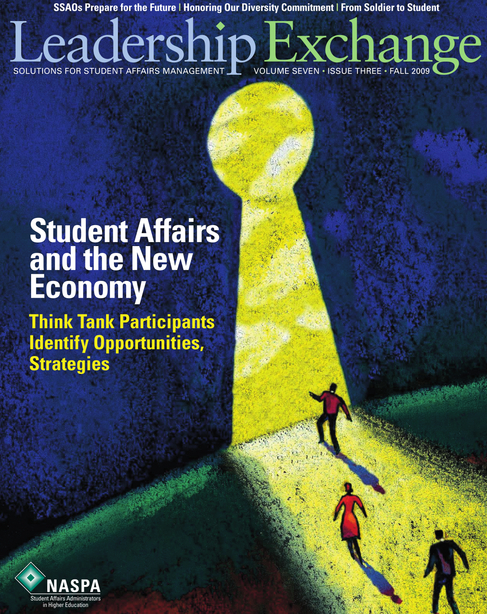
Celebrate good times! Tooting my horn that Eighteen and Life was featured among Websites to Watch in the Fall 2009 edition of Leadership Exchange, a NASPA publication. As the first anniversary of this blog approaches, it’s flattering to know that others find value here. I look forward to sharing more with you in the months to come. Thanks for reading!


The Dreaded ‘P’ Word: How Productive Are We?

The Dreaded ‘P’ Word: An Examination of Productivity in Public Secondary Education seeks to identify common indicators for determining productivity among institutions of higher education. Using an analysis of available funding resources, including state appropriations and tuitions revenues, in comparison to the production of graduates, author Patrick J. Kelly ranks the states based upon their ability to graduate students with degrees that have value in their state. Kelly’s argument for this research is that little progress has been made at the state level to gauge the return on investment in postsecondary education in comparison to other states. The report seeks to provide a productivity measure that is comparable across institutions.

This report highlighted an area that is lacking in higher education assessment, the ability to adequately measure states’ return on investment in postsecondary education. Kelly states that higher education is “not equipped with a wide variety of productivity measures that are directly comparable across institutions.” He adds that institutional missions may contribute to the lack of measurability and acknowledges that graduation rates may vastly differ based upon the socio-economic status of the student population. Kelly’s conclusion of the research is most telling in that “there is no evident relationship at the state level between resources and performance.” Some of the best performing states have the lowest resources, while some of the least productive have the largest resources.

Kelly suggests that it is important for states and systems of postsecondary education to identify benchmarks for productivity because only then can productivity be measured between states. At the same time he encourages more analysis of productivity levels of education so that overall productivity can be measured among states and against other countries. The report suggests that it should be an impetus for more research in postsecondary education, a beginning to the conversation that must occur about degree production based upon available resources.

How institutions spend resources and the outcomes they achieve require measurement if we are to continue advancing our postsecondary education systems. If institutions focus on indirect goals of productivity such as increasing graduation rates as opposed to increasing graduation rates in fields of study resourceful within the state, we will continue to be a nation challenged in this arena. In higher education, we cannot be afraid to seek the funding that is essential to support our students and institutions, but we must be willing to identify why it is needed.

Decision Making in Student Affairs

I was approached last week by one of our peer mentors who had scheduling difficulties with leadership responsibilities he had in other organizations. As the discussion progressed, my graduate assistant and I listened, nodded, and were ready to address how we could work with the student to find some scheduling middle ground. To our surprise, the student felt it was best that he resign from his position. I could tell he had given this a lot of thought, so I confirmed his intent, thanked him for his candor, and upon his departure, immediately jumped into action.


“Pull the updated course schedules of all peer mentors,” I quickly instructed a student assistant as I began scrolling through my cell phone numbers to contact the student’s co-leader. While schedules were being printed, I sent a text to the co-leader for a meeting after her classes. As I dashed between offices, checking class time availability and sending text replies, I stuck my head back in the door of my office where my graduate assistant was still seated.

“Do you want to sit down and process this so we can decide what to do,” he asked?

Sandy McMullen addresses questions like these over at Personality Plus in Business. Sandy, an artist and consultant, shares that the MBTI decision making functions of Thinking and Feeling have equal worth even though the quick deciding “Thinkers” are frequently valued in the workplace. She discusses the linear, logical processes utilized by those with the Thinking preference are in contrast to the more subjective review of values and merits required for those with a Feeling preference. Recognizing and using both of these processes can actually benefit our decision making.

Acknowledging that my graduate assistant was using his Feeling preference and was still in processing mode, I took a few steps back to invite a discussion as to what our next steps should be, even though, with my Thinking preference, I had already arrived there. We were able to have a good chuckle over viewing our preferences “in action”.

What does your decision making function look like?

Twitter me this…tools for campus


Found a great list of tools for utilizing Twitter in the classroom this week. Many of these applications would be fun for first-year seminar activities, but I think I may do some investigating for adding a dimension to our peer leadership course.


What is your experience with Twitter in the classroom? Any favorites on this list?

Have the time of your life!

Congratulations to the 2009 Hixson Scholars who begin the first day of their college career today. You should be very proud of the accomplishments that brought you to this point. There are a lot of people at home and here on campus who are really pulling for you, so make this opportunity count. There are fifteen peer mentors in our program who are as eager to meet you as I am. They are some of smartest student leaders with whom I have ever worked, so I know they will be great resources for you.


Don’t worry about dropping your tray in the dining center, getting on the wrong CyRide Bus, or getting lost on the way to class. Those things happen to everyone and we all survive. Focus on the big picture, the adventure on which you have embarked. See you in class tonight!


It’s something unpredictable
but in the end it’s right.
I hope you have the time of your life.
~Green Day

Celebrating Persistence

While introducing myself during our new student festival today, it occurred to me that it is the anniversary date of my career at Iowa State. I actually began working in my first student affairs job in August as well (back in the Stone Age), so lots to celebrate this month. It’s my half-birthday today too!


Professor and blogger Delaney Kirk celebrated her 28th year of teaching with a wonderful poem, so I was inspired to share a favorite quote with you.

Learning is finding out what we already know. Doing is demonstrating that you know it. Teaching is reminding others that they know just as well as you. You are all learners, doers, and teachers. ~ Richard Bach

College Students & Money: No new car, caviar, four star daydream

It’s handy having a international expert on financial literacy around when counseling first-year college students about managing their resources. Iowa State professor Tahira Hira is recognized for her work on consumer spending including debt and bankruptcy. As our graduates leave campus with some of the highest student loan debt in the nation, I feel an obligation to discuss personal finance during our first-year seminar.


Dr. Hira’s three main principles for college student financial well being:
  • Live within your means.
  • Spend less that you make.
  • Be mindful of borrowing, including consumer credit or students loans.
Spending plans are key to managing finances and Hira shares these tips for students:
  • Give yourself an allowance that fits your budget.
  • Balance your checkbook regularly.
  • Leave your credit cards at home to avoid impulse buying.
  • When going out for an evening, take only as much cash as you can afford with you.
  • Eliminate casual shopping.
  • Reduce stress with exercise, hobbies, or community service; versus shopping.
Our financial aid office partners with a great online tool called CashCourse that offers financial planning tools and economic tips. I utilize CashCourse for a personal finance assignment in our seminar course.

Quarters


Twenty-five cent coins met their demise in our Residence Halls several years ago when laundry room washers and dryers moved to digital payment via student ID cards. Students no longer hoarded rolls of quarters before moving to campus or worried about jammed coin dispensers. Now students are able to monitor machine availability and check if the wash cycle is finished, all via the internet.


Quarters used to equal the gold exchange rate in the residence hall. How will students shed the dreaded first-year fifteen if not running up and down stairs to check the nuclear baking cycle of the dryer? Will student engagement suffer when no one is negotiating over the next available washer? Sadly, it appears quarter status has been relegated to drinking game only.