Take your Vitamin C’s

Today was the 10th Annual Iowa State Conference on Race and Ethnicity (ISCORE). I have been on the planning committee for this conference since year two, and it has been amazing to see our growth each year. We welcomed more than 800 faculty, staff, and student participants to this 2009 event.


Our conference keynote speaker was NPR’s Michele Norris. In her SRO presentation, Race, Gender, and the Future of Leadership in America, Ms. Norris engaged us with observations of a year of political change through the storytelling for which she is known. She addressed our students directly by encouraging them to remember their Vitamin C’s.

Collaboration. Change happens when individuals lock arms together and march forward. Engage those around you to follow your dreams and beliefs and be supportive of what they bring to the effort.

Cut. Eliminate one activity, one committee, one obligation. Build an hour back in your day. College students today do too much with too little time. Cut back and make time for yourself.

Camaraderie. Don’t forget about your friends, they are the ones to get you through your day and your life. It’s easy to become so focused on goals and outcomes that you forget the people that you really need.

When asked whether our country is capable of moving toward a post-racial society, Ms. Norris shared that recent political events lead some to believe we have already achieved a post-racial place in America. Norris said this compares to riding an express elevator to the top of a skyscraper. You have a great ride and get out on the observation deck where the view is wonderful. But you fail to stop at the floors on the way up where the view is not so great.

What would we do if we really loved our students?


What would do if we truly loved our students? Those two questions were from Edward “Chip” Anderson in a presentation I attended a number of years ago, I can’t even recall which conference. Chip used that message to develop his work in Strengths-Based Educating, or building upon the natural talents of an individual versus improving deficiencies. Those powerful questions and their meaning have defined the work that I do.


On this February 14th, instead of waiting for flowers and chocolate, it is more important to share the love. 

Happy Valentine’s Day!

Facebookgate: Power to the students

A very interesting experiment in the power of social networks occurred on Friday. Several higher ed professionals uncovered evidence of a marketing scheme utilizing the very popular incoming freshman “Class Of” groups in Facebook and were sharing their findings on Twitter. Upon further digging they found hundreds of colleges and universities throughout the country with Class of 2013 groups created by the same small group of people. Additional detective work identified a college marketing group behind most of the pages, likely with the intent of mining students’ comments and posts on the Class of 2013 group pages.  Our university was the lucky recipient of two of these pages.


As we enroll a freshman class in the range of 4,500 students, it is not policy that we create and maintain official class pages for each new group of students. Instead we let the network of Facebook  groups develop naturally. The
Class of 2012 group last year had more than 1,200 student members and hundreds of discussion board conversations.


Armed with information from the Twitter discussion with other higher ed colleagues, I was able to identify that the Class of 2013 group creators and admins were not prospective students. I posted links to the story on each page and highlighted the group admins that were attempting to pose as our students. Next, I messaged a couple of students who were engaged in the groups and encouraged them to take ownership. By Friday afternoon, the marketing groups had relinquished admin rights on one page and switched admins on the other. I emailed the new admin requesting that he name our students as admins. After a couple of snarky email replies, he gave up his admin rights by the next evening.  The students who took admin rights for the pages are now cross-posting on each group and building relationships with the other student admins.

We have no official obligation to monitor or engage students on Facebook or other social networking sites to protect them from indiscriminate sharing of information or spam marketing. But just as I would stop a preoccupied person from stepping off a curb into oncoming traffic, it felt appropriate to empower students with all available information regarding their decisions. Particularly if that decision may ultimately affect their enrollment and engagement with the university.

What’s your take on all of this?

Read more on Facebookgate:


End-of-the-year Bonus


At the final semester banquet for our student leaders, lots of fun stories and jokes from throughout the past year were shared. These students were part of a year-long program of leadership and development training that includes first-year seminar course facilitation in the fall semester. 


As we were enjoying dessert, one of our seniors, Adam, mentioned that in his last class he shared with his students that I was the reason he was still in college. His co-leader, Kelsey, chimed in that Adam had indeed given a presentation on how he had made it through college with my help. Curious as to the reasoning, I asked Adam how I was of influence. 

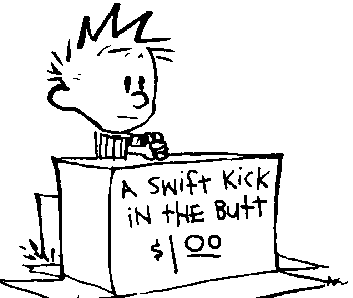
“You kicked my butt. And you didn’t stop kicking my butt until I straightened out.”


You see, Adam had a little difficulty with academic focus early on in his college career. We spent many an afternoon chatting about goals, grades, and graduation and why his current choices were not getting him closer to any of them. Eventually, Adam got it figured out. This year he is president of the academic club in his major in addition to serving as a peer mentor in our program. He will graduate in May.

And that is why I do what I do. The financial rewards in higher education will never rival CEO pay. Our hours are crazy, we don’t travel in private jets, and the temperature control in our buildings never seems to coincide with the season. But every once in a while, we get these little gems of appreciation from students that remind us that we touch lives. And kick butt. Which makes for a pretty nice end-of-the-year bonus in my book.


New in the Toolbox: Emotional Intelligence

My spare time this month has been used to prepare for and complete certification in the use of the Emotional Quotient inventory or 
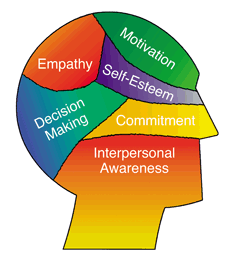
EQ-i. Emotional-social intelligence is a cross-section of interrelated emotional and social competencies, skills, and facilitators that determine how effectively we understand and express ourselves, understand and relate with others, and cope with daily demands. Understanding and assessing EQ in business and leadership coaching is common and research indicates that that the tool is equally useful in the academic setting with an 85% predictor rate for college success. I look forward to building expertise with this assessment and employing it to assist the transition of my first-year students.

The EQ-i is assessed through an online survey resulting in measurements of five areas: interpersonal, intrapersonal, stress management, adaptability, and general mood. Fifteen subscales or facets provide dimension to these scale areas.

EQ-i will join the College Student Inventory and MAP-Works in the toolbox of assessments that I rely upon for identifying issues challenging students in those first few crucial weeks of college. The College Student Inventory provides me with timely and strategic information on my students prior to their enrollment. Most importantly, it allows me to identify those with high need for student service intervention. MAP-Works is offered to students in the third week of enrollment and is a new complement to our campus retention initiatives. It aggregates student perception upon arrival and integration to the institution. Both surveys are great mediums for creating relationships with new students.

I will introduce the proportions of the EQ-i in greater depth with future posts.

What’s in your student retention toolbox?  

Our Bonds of Affection

We are not enemies, but friends. We must not be enemies. Though passion may have strained, it must not break our bonds of affection.

These words from Abraham Lincoln’s first inaugural were intended to piece together a fractured country. They offered connection at the end of American History X, punctuating the transition of a broken young man learning from the wrong of his actions.

The recent election results for this country have demonstrated that many Americans, including large populations in higher education, are seeking a new direction. We do not wish to go it alone, however, as our strength is in our numbers.