
Read the full comic at Doonesbury.
Read the full comic at Doonesbury.
I shared a variety of articles on student debt and financing education this month. Here they are, all in one place. You will find essential reading if you work in higher education and believe student success reaches beyond grades and graduation.
Senior citizens continue to bear burden of student loans
Student loan debt: Can these innovations save America’s workforce?
A Bank Account That Helps Pay Off Student Loans
Questions about tuition that goes toward scholarships
Rise in defaults renews “student debt bomb” warnings
Public university debt dips, but still up since 2009
Iowa State University will target rising student debt
The Census Bureau announced that three in ten adults held a bachelor’s degree in 2011. This is quite a jump considering that as recently as 1998 less than 25% of adults had a four-year degree. Regretfully, our global ranking for college degrees is still dropping. Despite continuing arguments about the value of certain degrees, it makes you think this whole college education thing may be catching on.
…the data suggest that going to school remains a shrewd investment. Median monthly pay for a professional degree reached $11,927 in 2009. That was more than twice the monthly pay for someone with a bachelor’s degree: $5,445. By contrast, a high school diploma was worth $3,179 a month, and an elementary school education yielded $2,136 a month. ~Daniel de Vise, Washington Post
More on the value of a college education…
I have written before about how challenging I find suggestions that college has no value. When research suggests that learning or critical thinking is not occurring on the college campus, I know that I see otherwise at my university, with my students. Does the academe have work to do? You bet. But creating a society of education privilege where only certain individuals are encouraged to pursue a degree is not an answer.
This Chronicle editorial suggests we are already creating that privilege by pricing a large portion of the population out of the higher education pool.
…going to college is worth it, but going to any college at any price may no longer be worth it. ~Jeff Selingo
But for another viewpoint here is an interesting debate of whether too many students are attending college. It highlights the argument that increased access to higher education has little influence on economic growth. And although I find this argument insulting to education and our students, it is worthy for discussion. Who decides who attends college?
To ask whether too many people are going to college begs another question: If too many people are going to college, then who are these people? How should we as a society ration a more restricted level of educational opportunity? ~Peter Sacks
Consider the students in your office today. Which ones could you single out as not being eligible for higher education?
I’ve got a problem. There are aspects of my personality that I can’t control. ~Bruce Banner
Much as student development theory helps us to understand differences in students served in higher education, understanding differences of psychological type in students may also enhance student success. The assessment of psychological type is based upon Carl Jung’s theory that human behavior is not random and that patterns of mental functions exist in the population. Following this conceptual foundation, the Myers-Briggs Type Indicator, MBTI™, has become the most widely used instrument for determining type preferences in business, personal coaching and on college campuses. It was developed by the mother-daughter team of Katherine Briggs and Isabel Briggs Myers with the foundations of orientation and organization to the outer world as a framework to guide individuals through the constructive use of differences. The MBTI instrument asks a series of self-report forced-choice questions to define individual preference opposites for personal energy, taking in information, making decisions, and organizing one’s world. Based upon responses to these questions, an individual is assigned a type preference for each pair of opposites which when combined; create sixteen individual four-letter type codes.
There are four MBTI type dichotomies or opposite preferences and each has a different influence on learning. The word preference is used to refer to the innate tendency one has in each of the psychological dichotomies. The principle of preference is frequently illustrated in type facilitations by asking participants to write their signature with their non-dominant hand. Generally, participants will describe this exercise as awkward, uncomfortable or not a preferred activity, but one they are able to complete. Each individual has a preference for daily functions, but is able to operate out of preference, as needed. The preference pairs include where a person gets their energy, categorized as Extraversion and Introversion; how an individual takes in information or Sensing and Intuiting; the decision-making process of Thinking and Feeling; and the orientation to and organization in the outer world of Judging and Perceiving. Individuals use each aspect of the personality pairs daily, but have a preference for one that is more comfortable or useful to the self.
Extraversion and Introversion. Extraversion and Introversion are expressions of where an individual gathers personal energy. Extraversion (E) is the energy that develops from engaging with people, objects and events. Externally expressing interests and interacting with others is invigorating for extraverts. They learn best in situations that include movement, action and conversation and prefer to connect theories and facts with personal experience. Introversion (I) is a reflective, inward coordination with thoughts and ideas. Introverts look internally for thoughts and energy. They think best in solitude and prefer advance notice before sharing or acting in a learning situation.
Sensing and Intuition. Sensing and Intuition are the functions for absorbing information. The Sensing (S) perception is the process of awareness and accumulating information through the physical senses. Sensing is a pragmatic function relying on details, sequenced lists, and consistency. Sensors learn best with sequential learning from concrete to abstract and tend to excel at memorization. The Intuitive (N) perception is future oriented and uses hunches and sees possibilities to provide explanations. Intuitive preference persons value patterns and abstract ideas and learn through imaginative tasks and theoretical topics with ease.
Thinking and Feeling. Thinking and Feeling are the decision-making or judgment processes of type. Thinking (T) is the objective decision-making process using standards and criteria to analyze information or situations to improve situations or performance. Thinking preference individuals are motivated in learning by logic and respect for their competence. The Feeling (F) decision-making preference is subjective and based upon personal values for accommodating harmony and the improvement of personal conditions for others. Individuals with Feeling preference are motivated in learning by personal encouragement, values and the human dimension of a topic or lesson.
Judging and Perceiving. Judging (J) is the process of engaging with the outer world preferring organization, structure, and a planned life. Those preferring Judgment tend to experience time in specific segments. They are driven to seek closure or finish tasks in those specific time periods. Judging preference learning thrives on task completion, structured learning and specific goals. The Perceiving (P) preference values autonomy, flexibility and spontaneity. They experience time as an uninterrupted flow and are open to new information as they experience and process. They prefer open learning environments that rely less on deadlines and structure.
Psychological type assessment can been helpful in allowing detection of interpersonal roadblocks and miscommunication related to type preferences, particularly for students in the transition from high school to college. Through intentional examination of type and how it relates to learning preferences, opportunities emerge for enabling students to understand more about themselves in this transition. Although the MBTI is not designed to be a predictor, examining type preference anomalies to enhance student services and resources may lead to increased student success and retention.
What is your type? Do you use the MBTI in your student success initiatives?
There are those occasional days when perhaps it is raining buckets and you are in back to back meetings making your head spin and you finally make it home and just need something to make you smile. And as today was one of those days, what made me smile was this post on the zen wisdom found in a video of a little horse chasing a giant ball. Thanks to Jennifer Blackwell for sharing.
Read more about Einstein and be sure to check out the video and his Twitter. You’ll smile too.

Welcome to the third anniversary of eighteen and life! Over the last three years, the pages of this blog have been filled with ideas and thoughts on my career in student affairs. It is special work that we do in guiding, shaping, and celebrating students. And it is new every day.
Steve Jobs described it best in his 2005 Stanford commencement address.
Your work is going to fill a large part of your life, and the only way to be truly satisfied is to do what you believe is great work. And the only way to do great work is to love what you do. If you haven’t found it yet, keep looking. Don’t settle. As with all matters of the heart, you’ll know when you find it.

I am reading the article Individuals Perform Better When Focused on Team. It has a lot of relevance for my children’s soccer games, but it also resonates with our student leadership course and especially for working with my colleagues in student affairs. Try changing your “I” to a “We” today and see what you can accomplish.
By focusing on the team, you include yourself without putting the focus or extra pressure on yourself. ~Deborah Feltz
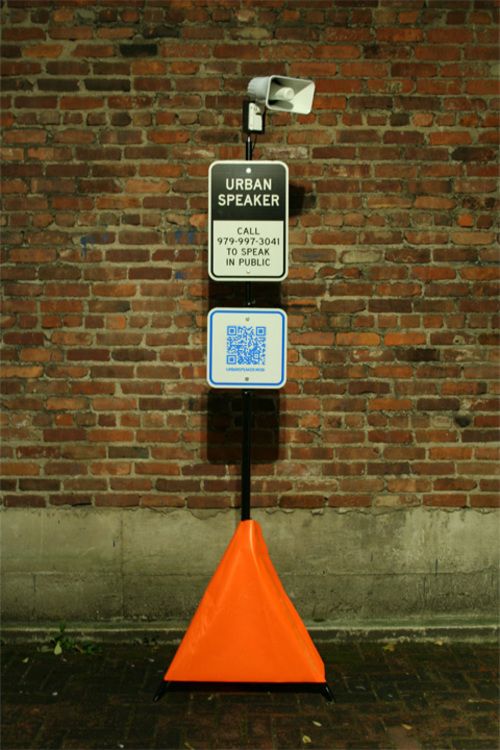
Tom Krieglstein shared a blog post last week featuring this Urban Speaker, an outdoor art installation by Carlos J. Gomez de Llarena. It was intended to offer an instant stage for public communication.
I shared with a colleague that having my own urban speaker, or Campus Speaker, would be quite handy as my office overlooks a major residence hall thoroughfare.
Things I would share on my Campus Speaker:
Hey, you! Walking through the landscaping! They call it a sideWALK for a reason!
Hey, you! Please use the crosswalk! You are becoming a retention risk!
Yo! You on the motorcycle! SLOW DOWN! This is a residential area!
And today I could add things like, “Congrats to the Cyclone Volleyball team for sweeping Iowa in three sets!”
What would you share on your Campus Speaker?
Helping students understand how to effectively manage student loan debt is a bit of a project for me. I spend much of my professional work counseling first-generation college students, most of whom have high financial need. I have shared my views on the student debt crisis here, here, and here.
Andrew Hacker and Claudia Dreifus present some excellent alternative plans for lowering student costs in higher education by encouraging students to choose community colleges and state institutions. And although I disagree with their portrayal of unscrupulous financial aid officers when describing the individuals at my own institution, I do not doubt that they are out there.
The next subprime crisis will come from defaults on student debts, starting with for-profit colleges and rising to the Ivy League. The parallels with housing are striking. In both, the written warnings aren’t understood, especially on penalties and interest rates. And in both, it’s assumed that what’s being bought will rise in value, in one case the real estate, in the other the salaries which will accrue with a degree. One bubble has burst; the second is already losing air.
 eighteen and life