Digital Storytelling: Adventures in the First-Year Experience

Like many institutions, my university participates in the National Survey of Student Engagement (NSSE) to measure programs and activities that enhance student learning and personal development. The purpose of NSSE is to help identify areas to improve the undergraduate experience in and out of the classroom.

The scholarship program that I coordinate hosts a first-year seminar course each fall for the 100 recipients of the award. The course is loosely based on the University 101 model framed by John Gardner when he was at the University of South Carolina. It follows an orientation and transition format and includes community-building activities for our program. We have a large group lecture for one hour each week and students meet in recitation groups of a dozen students for a second hour weekly.

In the NSSE spirit of enhancing the course experience and engaging our students, we try to integrate fun and a bit of technology for student projects. Our latest adventure was digital storytelling. Staff and peer mentors selected random movie genres, and a student from each recitation section drew from the genre options. We shared examples of digital storytelling and creating storyboards. We suggested task assignments such as videographer, actor, writer, and film editing to help the project go more smoothly. We made certain to review campus computer labs for the appropriate editing software in advance and provided this information to students. Finally, we stocked up on sale priced Flip Camcorders and gave this assignment to students:

  • Create a media project that embodies the transition to college and your first semester experience.
  • Final Project: No longer than 5 minutes and must include a flash mob.

The final productions were screened during our class “Film Festival” complete with popcorn and soda. Students were encouraged to vote for “Best Picture” and create award categories to fit the projects. Winning productions were featured on our student-run cable news channel.


There were a few bumpy roads throughout the ten-week project, but overall the response and student evaluations of the project assured us that students were engaged and most importantly, community was achieved. On an unexpected side note, our first semester grade point average rose to the highest level in five years, with no change in entering student academic profile. Of course we already look forward to repeating the project with our next student cohort.


Check out the final productions and let me know what you think.

Mystery/Thriller

Blair Witch

Western

Romantic Comedy

Action/Adventure

Musical

Crime/Gangster Part I and Part II

Zombie

Like a box of chocolates


Like many of my colleagues in student affairs, my first job in the profession was the result of a student leadership experience, student tour guide to be exact. My work as an admissions tour guide as an undergraduate later led to a position as an admissions recruiter for a small private college. I like to think that working in admissions, helping students with their college decision-making, is where I honed facilitation skills that are critical to my current work. I had a couple of gigs as a director of admissions before turning my sights to program coordination.

Stanford business professor Robert Sutton suggests employees need predictability, understanding, control, and compassion. As anyone who has spent even a few months in a student affairs position can tell you, those items are few and far between. You learn early in your career that student affairs hours include nights, weekends, and other duties as assigned. The concerns of an 18-year old in college differ from year to year. Reactions to course assignments or program activities may not communicate their message or be perceived as useful. Faculty and academic units question the value of student affairs programming and services, particularly in challenging financial times. Student affairs professionals do, however, provide predictability, understanding, control, and compassion…for our students.

The graduate assistants who have worked in my unit over the years have enhanced my work and life. They went from grad to pro and are now high school teachers, logistics managers, academic advisors, independent consultants, and campus activity and orientation coordinators. Each of these individuals had an opportunity to make a difference in student lives. They used their creativity, energy, and enthusiasm to make our university a better place for students. When I think of my colleagues at the Student Affairs Collaborative, you may find us in campus activities, student union management, leadership development, residence life, career planning, scholarship programs, and consulting. Those paper titles do not include the personal counseling, financial advising, academic enhancement, and other duties as assigned that we provide on a daily basis.

I borrowed the title for this post from a former graduate assistant who is now blazing trails of her own. She used the analogy that Student Affairs is like a box of chocolates for a course assignment and it really stuck with me.

Student Affairs is:

  • Being a generalist in helping, listening, organizing, and facilitating, while a specialist in your position.
  • Never growing up as you surround yourself with 18-22 year olds.
  • Spending your life by the academic year calendar.
  • Justifying your existence with the belief that higher education is also about the out-of-classroom experience.
  • A real profession.

Student Affairs professionals work hard to make our colleges and universities more welcoming, engaging, and understanding for students because we believe in higher education and all that it offers. We get up every morning and face the day with a smile, because we never know what we’re going to get.

How do you define your work in student affairs?

Shined in 2009

Your favorite posts at eighteen and life in 2009 were on the friendly discussion that ensued when a training course for Facebook was offered at our university of science and technology. I wrote about my incredulousness of this topic requirement and then captured a similar Twitter conversation between an IT director and professor on our campus. Enjoy.


Divine 2009…Zen 2010?

Reflecting on 2009, there is much to celebrate, but many more reasons to be excited for the year ahead.

Adventures in student success and the first-year seminar: I may have mentioned a time or two that I work with the best students in the world. They challenge and inspire me every day of the year. I love my job.
Road trip with 120 students
Digital Storytelling Project
Blogging
Tom Krieglstein
Vernon Wall
Marshmallow Wars

Adventures in Student Affairs: With tight budgets and reduced funding, most of my professional development in 2009 did not cost a cent. I interact daily with wonderful student affairs professionals and treasure their connections.
Class with John Schuh

Adventures in Type: I made inspiring connections through MBTI and the Association for Psychological Type International (APTi) in 2009 and volunteered for some new professional duties.
APTi Conference
Vice President for Professional Development, APTi eChapter
Director of Communications, APTi
Collaboration with Dan Robinson

Year’s end is neither an end nor a beginning but a going on, with all the wisdom that experience can instill in us. ~Hal Borland

Mission of First-Year Programs

First-year programming on most campuses originated from the topic of retention of students to the second year of college and persistence to graduation. Specific reasons are related to resources and the direct relationship between retention to enrollment and institutional income. With that in mind, most first-year program mission statements are framed around increasing academic performance and retention. Ball State, University of South Carolina, and Appalachian State are among those recognized as Institutions of Excellence in the First College Year. Their first-year program mission statements reflect this retention theme.


Ball State University’s Freshman Connections mission is to accelerate the process for new students to learn and succeed at Ball State. The program “seeks to deepen the contact new students have with faculty, staff, and fellow students in order to improve learning and persistence to graduation”. Fostering academic success, helping students to discover and connect with the university, and preparing student for responsible lives are the tenets of the University of South Carolina’s first-year learning outcomes. They fall under the overarching goal of helping new students make a successful transition, both academically and personally. Appalachian State’s Watauga Community is “structured to develop students’ expertise in the skills to evaluate and integrate relevant and quality information from different knowledge sources through individual and collaborative processes”. With focuses on connections and building community membership, each of these first-year mission goals strives to enhance retention and promote student success.

A History of First-Year Experience Programs

As the first-year college experience is a lot of the discussion here at eighteen and life, I thought you may appreciate a little historical reference.

College orientation, or programming focused on the student adjustment to the new academic environment, is recognized as the precursor to first-year experience programs. Early programs grouped students by housing and assigned advisers to guide new students in their education quest. Johns Hopkins University had formed a system of faculty advisors by 1877 and Harvard University had a board of freshman advisors on record in 1889 (Gordon, 1989). First-year seminar courses were later added to the early orientation structure to more fully develop the first-year experience. A first-year course initiated at Boston University in 1888 is recognized as one of the first organized orientation courses while the first orientation course for credit originated at Reed College in 1911 (Gordon, 1989). More than 82 first-year courses were available by 1925-26 with topics ranging from adjustment to college, study skills, current events, citizenship, and reflective thinking. A third of all colleges and universities offered these courses in the 1930’s and by 1948 a survey reported that 43% of institutions had required orientation courses in the curriculum (Gordon, 1989).

Faculty objections to course credit for non-academic orientation courses soon led to the downfall in their offering and fewer courses could be found on the college campuses of the middle to latter half of the 20th century. The political unrest of the 1960’s and early 1970’s resulting in campus demonstrations and protests led to an even wider divide between students and universities. The University of South Carolina is credited with acknowledging this rift and initiating a plan to link students with the university in the first-year. This led to resurgence in the popularity of the first-year seminar and other first-year student programming (Saunders and Romm, 2008). In addition to addressing the needs of new direct from high school students, first-year programs also attended to the “new college student” as students transitioned from individuals of financial means to more adult, first-generation, and less-academically prepared students. Higher education professionals again “sought ways of helping freshmen make the transition from high school or work to the college environment” (Gordon, 1989, p. 188).

Throughout the 1980’s, first-year experience courses and programs grew and evolved as institutions gave consideration to the transition experience of a growing diverse student population. Kuh, Kinzie, Schuh, Whitt & Associates (2005) reported that many of the DEEP (Documenting Effective Educational Practice) institutions are skilled at guiding transitions for student success in college and frequently require first-year experience courses or provide additional programs and activities that serve this function. First-year programs including summer orientation through seminar courses are now widely ingrained on the college and university campus and are promoted as important retention strategies common in the student transition to college.


Gordon, V. N. (1989). Origins and purposes of the freshman seminar. In M. L. Upcraft, J. N. Gardner, and Associates (Eds.), The freshman year experience: helping students survive and succeed in college. San Francisco: Jossey-Bass.

Kuh, G. D., Kinzie, J. Schuh, J. H., Whitt, E. J., & Associates (2005). Student success in college: creating conditions that matter. San Francisco: Jossey-Bass.

Saunders, D. F. & Romm, J. (2008). An historical perspective on first-year seminars. In B. F. Tobolowsky & Associates, 2006 National Survey of First-Year Seminar: Continuing innovations in the collegiate curriculum (Monograph No. 51, pp. 1-4). Columbia, SC: University of South Carolina, National Resource Center for the First-Year Experience and Students in Transition.

Gridiron Challenge and Support

Nevitt Sanford (1967) developed his theory for student development based on providing a balance of challenge and support. Too much support with too little challenge creates a cushy environment for the student, where development is unlikely to occur. However, the opposite of too little support with too much challenge also makes development an impossible and negative experience.

One of the “other duties as assigned” in which our dean of students office staff has the opportunity to participate is football game duty. We partner with the athletics department in an effort to keep the student seating section a safe and fun place to enjoy the game. Each home game, a few staff sign up to attend the game and join our students in the stadium. We arrive before the gates open and greet students who stand in line for hours to race down the stadium steps for a seat in the front row. When seated, we distribute wristbands to the students who made it to the front so that they are able to maintain those seats throughout the game.


Our students are big fans. For the most part, if you have been standing in line for four or five hours, you haven’t been taking part in other extracurricular activities that historically take place prior to a football game. So, we work the crowds, meeting students, helping with body paint, and taking photos for students posing with the school mascot.

I call it friend-raising. It gets us out with the people that really count, our students. The ones that we want to be successful and graduate from the university. It’s also about providing support and encouraging students to make good choices. Because that is what we do in student affairs.

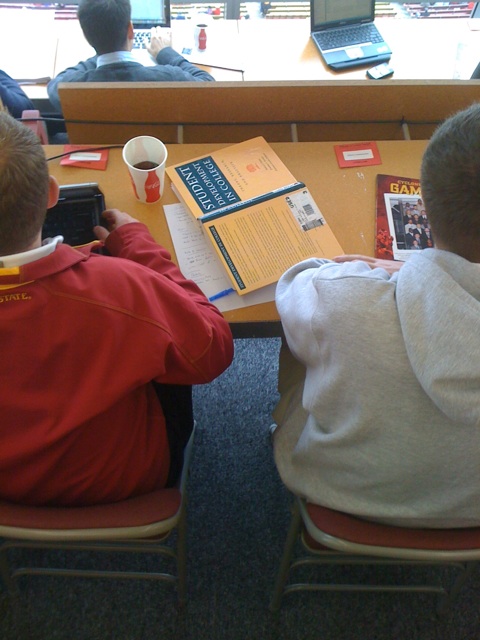
Photo note: Yes, that is a photo of someone in the stadium press box today with a copy of Student Development in College. Yes, he may be an even bigger student affairs geek than me. I never take my books to the game.

Sanford, N. (1967). Self & society: social change and individual development. New York, NY: Atherton Press.


Second star to the right and straight on till morning

The flying public had a bit of a scare last week when it was discovered that a flight from San Diego to Minneapolis overflew it’s destination by 150 miles and was out of radio contact for 90 minutes. The pilots were apparently engrossed in a new scheduling software on their laptops. Their lapse in judgment cost them their pilot licenses and will likely result in the loss of their jobs.


At about the same time the media was publicizing the revocation of licenses, I was boarding a United Airlines jet in Denver, bound for a meeting in Los Angeles. Shortly after the cabin doors closed, the pilot, Captain Berner, could be seen making his way though the plane. Any frequent flier knows that this is a bit unusual directly before departing the gate.

Captain Berner stopped to chat with passengers every few rows discussing the turbulence we would likely encounter in route and our estimated flight time. He joked that we would make it to L.A. in two hours where as if we had decided to go by horseback, it would take us six months. After traveling through all the rows, he headed back to the cockpit to get us up in the air.

A quick survey of the passengers in my vicinity confirmed that none of us had ever had a pilot welcome after boarding any plane. So what was this? Likely, it was an United Airlines email memo to pilots on restoring trust with the flying public that had just been circulated. Cynicism aside, it had us smiling and perhaps just a bit more confident that we would arrive at our appropriate destination.

What have you done to reassure your students today?

All it takes is faith and trust and a little bit of pixie dust. ~Peter Pan