My 2013 one word is DO. And to be precise, it is not Do. It is DO.
As I reflect on projects nearly completed and opportunities ahead, it makes sense.
My 2013 one word is DO. And to be precise, it is not Do. It is DO.
As I reflect on projects nearly completed and opportunities ahead, it makes sense.

When I read yet another article minimizing the value of a college education I am challenged by thoughts of privilege. Yes, Steve Jobs, an individual I greatly admire, was a college dropout, but at least he had the opportunity to give it a try. Mark Zuckerberg’s intelligence and initiative is without question, but how many students can realistically include Harvard on their college wish list? And then walk away from the opportunity?
I do not discount hard work, enterprise, and determination. But for those of us who are simply above-average, or first-generation, or of a marginalized population, college is the pathway to get a step ahead, a leg up, a move toward potential success. Yes, student loan debt and college costs demand answers, but denying the value of learning, but for an elite few, is not the answer. Just say Go. Go to college.
I caught a segment on my favorite morning program last week featuring General Colin Powell promoting his new book. The book includes thoughts on life and leadership including thirteen rules that have framed Powell’s leadership vision. I am not certain if I was having an introspective moment, but the words resonated with me so much that I picked up the book later that day. I am still reading, but here are the basics. Think about a challenging situation that you have recently faced…the rules may have meaning for you, as well.
I have written before about how challenging I find suggestions that college has no value. When research suggests that learning or critical thinking is not occurring on the college campus, I know that I see otherwise at my university, with my students. Does the academe have work to do? You bet. But creating a society of education privilege where only certain individuals are encouraged to pursue a degree is not an answer.
This Chronicle editorial suggests we are already creating that privilege by pricing a large portion of the population out of the higher education pool.
…going to college is worth it, but going to any college at any price may no longer be worth it. ~Jeff Selingo
But for another viewpoint here is an interesting debate of whether too many students are attending college. It highlights the argument that increased access to higher education has little influence on economic growth. And although I find this argument insulting to education and our students, it is worthy for discussion. Who decides who attends college?
To ask whether too many people are going to college begs another question: If too many people are going to college, then who are these people? How should we as a society ration a more restricted level of educational opportunity? ~Peter Sacks
Consider the students in your office today. Which ones could you single out as not being eligible for higher education?

It’s like you come onto this planet with a crayon box. Now you may get the 8-pack, you may get the 16-pack but it’s all in what you do with the crayons – the colors – that you’re given. Don’t worry about coloring within the lines or coloring outside the lines – I say color outside the lines, you know what I mean? Color all over the page; don’t box me in! We’re in motion to the ocean. We are not land locked, I’ll tell you that. ~Boat Car Guy, Waking Life
Jesus. Ghandi. Mother Teresa. Martin Luther King, Jr. Amelia Earhart. Walt Disney. Harriet Tubman. John Lennon. Joan of Arc. George Washington. The greatest, most inspiring figures in the history of mankind have one thing in common: they were non-conformists. They colored WAY outside the lines. ~Jason Kotecki
I’ve got a problem. There are aspects of my personality that I can’t control. ~Bruce Banner
Much as student development theory helps us to understand differences in students served in higher education, understanding differences of psychological type in students may also enhance student success. The assessment of psychological type is based upon Carl Jung’s theory that human behavior is not random and that patterns of mental functions exist in the population. Following this conceptual foundation, the Myers-Briggs Type Indicator, MBTI™, has become the most widely used instrument for determining type preferences in business, personal coaching and on college campuses. It was developed by the mother-daughter team of Katherine Briggs and Isabel Briggs Myers with the foundations of orientation and organization to the outer world as a framework to guide individuals through the constructive use of differences. The MBTI instrument asks a series of self-report forced-choice questions to define individual preference opposites for personal energy, taking in information, making decisions, and organizing one’s world. Based upon responses to these questions, an individual is assigned a type preference for each pair of opposites which when combined; create sixteen individual four-letter type codes.
There are four MBTI type dichotomies or opposite preferences and each has a different influence on learning. The word preference is used to refer to the innate tendency one has in each of the psychological dichotomies. The principle of preference is frequently illustrated in type facilitations by asking participants to write their signature with their non-dominant hand. Generally, participants will describe this exercise as awkward, uncomfortable or not a preferred activity, but one they are able to complete. Each individual has a preference for daily functions, but is able to operate out of preference, as needed. The preference pairs include where a person gets their energy, categorized as Extraversion and Introversion; how an individual takes in information or Sensing and Intuiting; the decision-making process of Thinking and Feeling; and the orientation to and organization in the outer world of Judging and Perceiving. Individuals use each aspect of the personality pairs daily, but have a preference for one that is more comfortable or useful to the self.
Extraversion and Introversion. Extraversion and Introversion are expressions of where an individual gathers personal energy. Extraversion (E) is the energy that develops from engaging with people, objects and events. Externally expressing interests and interacting with others is invigorating for extraverts. They learn best in situations that include movement, action and conversation and prefer to connect theories and facts with personal experience. Introversion (I) is a reflective, inward coordination with thoughts and ideas. Introverts look internally for thoughts and energy. They think best in solitude and prefer advance notice before sharing or acting in a learning situation.
Sensing and Intuition. Sensing and Intuition are the functions for absorbing information. The Sensing (S) perception is the process of awareness and accumulating information through the physical senses. Sensing is a pragmatic function relying on details, sequenced lists, and consistency. Sensors learn best with sequential learning from concrete to abstract and tend to excel at memorization. The Intuitive (N) perception is future oriented and uses hunches and sees possibilities to provide explanations. Intuitive preference persons value patterns and abstract ideas and learn through imaginative tasks and theoretical topics with ease.
Thinking and Feeling. Thinking and Feeling are the decision-making or judgment processes of type. Thinking (T) is the objective decision-making process using standards and criteria to analyze information or situations to improve situations or performance. Thinking preference individuals are motivated in learning by logic and respect for their competence. The Feeling (F) decision-making preference is subjective and based upon personal values for accommodating harmony and the improvement of personal conditions for others. Individuals with Feeling preference are motivated in learning by personal encouragement, values and the human dimension of a topic or lesson.
Judging and Perceiving. Judging (J) is the process of engaging with the outer world preferring organization, structure, and a planned life. Those preferring Judgment tend to experience time in specific segments. They are driven to seek closure or finish tasks in those specific time periods. Judging preference learning thrives on task completion, structured learning and specific goals. The Perceiving (P) preference values autonomy, flexibility and spontaneity. They experience time as an uninterrupted flow and are open to new information as they experience and process. They prefer open learning environments that rely less on deadlines and structure.
Psychological type assessment can been helpful in allowing detection of interpersonal roadblocks and miscommunication related to type preferences, particularly for students in the transition from high school to college. Through intentional examination of type and how it relates to learning preferences, opportunities emerge for enabling students to understand more about themselves in this transition. Although the MBTI is not designed to be a predictor, examining type preference anomalies to enhance student services and resources may lead to increased student success and retention.
What is your type? Do you use the MBTI in your student success initiatives?
Welcome to the third anniversary of eighteen and life! Over the last three years, the pages of this blog have been filled with ideas and thoughts on my career in student affairs. It is special work that we do in guiding, shaping, and celebrating students. And it is new every day.
Steve Jobs described it best in his 2005 Stanford commencement address.
Your work is going to fill a large part of your life, and the only way to be truly satisfied is to do what you believe is great work. And the only way to do great work is to love what you do. If you haven’t found it yet, keep looking. Don’t settle. As with all matters of the heart, you’ll know when you find it.

I am reading the article Individuals Perform Better When Focused on Team. It has a lot of relevance for my children’s soccer games, but it also resonates with our student leadership course and especially for working with my colleagues in student affairs. Try changing your “I” to a “We” today and see what you can accomplish.
By focusing on the team, you include yourself without putting the focus or extra pressure on yourself. ~Deborah Feltz
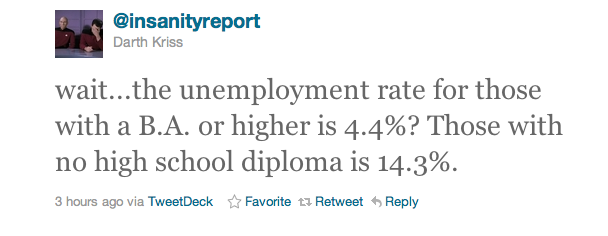
The monthly jobs report was released this morning, It showed that even in our current tough economy, lo and behold, unemployment for those with a college education is considerably below the national averages. Go figure.
As a student affairs professional and higher education advocate, I am exhausted by recent events discounting the value of a college degree. Yes, I am looking at you, Mr. Stanford Educated Peter Thiel. Thankfully, there are enough critical thinkers in the media who are willing to defend the value of education from stories such as: Debt-Laden Graduates Wonder Why They Bothered With College.
Why the Media is Always Wrong About the Value of a College Degree
The Long, Sad History Of ‘College Not Worth It Anymore’ Articles
And my logical thinking favorite:
Where is the Best Place to Invest $102,000–In Stocks, Bonds, or a College Degree?
…the recession has not fundamentally changed the math: although a college degree has upfront costs, it is important to remember that it is an investment that pays off over time.

 eighteen and life