Digital Storytelling: Adventures in the First-Year Experience

Like many institutions, my university participates in the National Survey of Student Engagement (NSSE) to measure programs and activities that enhance student learning and personal development. The purpose of NSSE is to help identify areas to improve the undergraduate experience in and out of the classroom.

The scholarship program that I coordinate hosts a first-year seminar course each fall for the 100 recipients of the award. The course is loosely based on the University 101 model framed by John Gardner when he was at the University of South Carolina. It follows an orientation and transition format and includes community-building activities for our program. We have a large group lecture for one hour each week and students meet in recitation groups of a dozen students for a second hour weekly.

In the NSSE spirit of enhancing the course experience and engaging our students, we try to integrate fun and a bit of technology for student projects. Our latest adventure was digital storytelling. Staff and peer mentors selected random movie genres, and a student from each recitation section drew from the genre options. We shared examples of digital storytelling and creating storyboards. We suggested task assignments such as videographer, actor, writer, and film editing to help the project go more smoothly. We made certain to review campus computer labs for the appropriate editing software in advance and provided this information to students. Finally, we stocked up on sale priced Flip Camcorders and gave this assignment to students:

  • Create a media project that embodies the transition to college and your first semester experience.
  • Final Project: No longer than 5 minutes and must include a flash mob.

The final productions were screened during our class “Film Festival” complete with popcorn and soda. Students were encouraged to vote for “Best Picture” and create award categories to fit the projects. Winning productions were featured on our student-run cable news channel.


There were a few bumpy roads throughout the ten-week project, but overall the response and student evaluations of the project assured us that students were engaged and most importantly, community was achieved. On an unexpected side note, our first semester grade point average rose to the highest level in five years, with no change in entering student academic profile. Of course we already look forward to repeating the project with our next student cohort.


Check out the final productions and let me know what you think.

Mystery/Thriller

Blair Witch

Western

Romantic Comedy

Action/Adventure

Musical

Crime/Gangster Part I and Part II

Zombie

Like a box of chocolates


Like many of my colleagues in student affairs, my first job in the profession was the result of a student leadership experience, student tour guide to be exact. My work as an admissions tour guide as an undergraduate later led to a position as an admissions recruiter for a small private college. I like to think that working in admissions, helping students with their college decision-making, is where I honed facilitation skills that are critical to my current work. I had a couple of gigs as a director of admissions before turning my sights to program coordination.

Stanford business professor Robert Sutton suggests employees need predictability, understanding, control, and compassion. As anyone who has spent even a few months in a student affairs position can tell you, those items are few and far between. You learn early in your career that student affairs hours include nights, weekends, and other duties as assigned. The concerns of an 18-year old in college differ from year to year. Reactions to course assignments or program activities may not communicate their message or be perceived as useful. Faculty and academic units question the value of student affairs programming and services, particularly in challenging financial times. Student affairs professionals do, however, provide predictability, understanding, control, and compassion…for our students.

The graduate assistants who have worked in my unit over the years have enhanced my work and life. They went from grad to pro and are now high school teachers, logistics managers, academic advisors, independent consultants, and campus activity and orientation coordinators. Each of these individuals had an opportunity to make a difference in student lives. They used their creativity, energy, and enthusiasm to make our university a better place for students. When I think of my colleagues at the Student Affairs Collaborative, you may find us in campus activities, student union management, leadership development, residence life, career planning, scholarship programs, and consulting. Those paper titles do not include the personal counseling, financial advising, academic enhancement, and other duties as assigned that we provide on a daily basis.

I borrowed the title for this post from a former graduate assistant who is now blazing trails of her own. She used the analogy that Student Affairs is like a box of chocolates for a course assignment and it really stuck with me.

Student Affairs is:

  • Being a generalist in helping, listening, organizing, and facilitating, while a specialist in your position.
  • Never growing up as you surround yourself with 18-22 year olds.
  • Spending your life by the academic year calendar.
  • Justifying your existence with the belief that higher education is also about the out-of-classroom experience.
  • A real profession.

Student Affairs professionals work hard to make our colleges and universities more welcoming, engaging, and understanding for students because we believe in higher education and all that it offers. We get up every morning and face the day with a smile, because we never know what we’re going to get.

How do you define your work in student affairs?

Shined in 2009

Your favorite posts at eighteen and life in 2009 were on the friendly discussion that ensued when a training course for Facebook was offered at our university of science and technology. I wrote about my incredulousness of this topic requirement and then captured a similar Twitter conversation between an IT director and professor on our campus. Enjoy.


Gridiron Challenge and Support

Nevitt Sanford (1967) developed his theory for student development based on providing a balance of challenge and support. Too much support with too little challenge creates a cushy environment for the student, where development is unlikely to occur. However, the opposite of too little support with too much challenge also makes development an impossible and negative experience.

One of the “other duties as assigned” in which our dean of students office staff has the opportunity to participate is football game duty. We partner with the athletics department in an effort to keep the student seating section a safe and fun place to enjoy the game. Each home game, a few staff sign up to attend the game and join our students in the stadium. We arrive before the gates open and greet students who stand in line for hours to race down the stadium steps for a seat in the front row. When seated, we distribute wristbands to the students who made it to the front so that they are able to maintain those seats throughout the game.


Our students are big fans. For the most part, if you have been standing in line for four or five hours, you haven’t been taking part in other extracurricular activities that historically take place prior to a football game. So, we work the crowds, meeting students, helping with body paint, and taking photos for students posing with the school mascot.

I call it friend-raising. It gets us out with the people that really count, our students. The ones that we want to be successful and graduate from the university. It’s also about providing support and encouraging students to make good choices. Because that is what we do in student affairs.

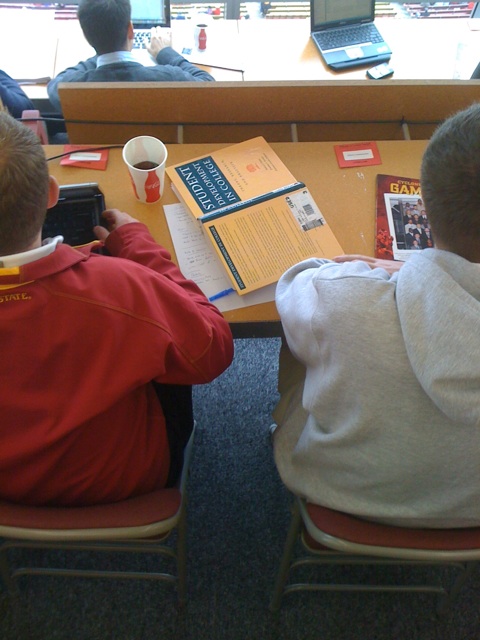
Photo note: Yes, that is a photo of someone in the stadium press box today with a copy of Student Development in College. Yes, he may be an even bigger student affairs geek than me. I never take my books to the game.

Sanford, N. (1967). Self & society: social change and individual development. New York, NY: Atherton Press.


A Year of Reflections on the First-Year Experience

Thanks for joining me this past year at Eighteen and Life for reflections on the first-year college experience and building a career on the wisdom of 18-year olds. Today, this blog is one year old. Although my work in student affairs is certainly not exclusive to first-year students, they are the students with whom I spend the majority of my time. The transition to any college or university can be a challenge. Each day, I get to help ease that transition in my little corner of the higher education world. We’ve come a long way.

The word freshman first appeared in the English language in 1550, when it was used to describe a newcomer or a novice in any field of endeavor. Only in the 1590’s did the word come to have specific reference to first-year students in an English university. The term was carried over to America in the next century. The first American freshmen, of course, were at Harvard. Harvard also inaugurated the first system of freshman counselors to ease the young man’s transition from home to college. ~John Orr Dwyer in The Freshman Year Experience

Catch and Release

The story of an Italian family who so smothered the social growth of their 12-year old boy that they are now being charged with child abuse was featured in Time Magazine this week. The boy had the motor skills of a toddler and had been so overprotected that that he could not mentally or physically keep up with children his own age. The article also cited a recent psychological study finding that 37% of Italian men from the ages of 30 to 34 still live with their mothers. Which makes me think that perhaps the hovering helicopter parents that we encounter in U.S. higher education are not all that bad.

In my student affairs work with first-generation college students and their families, I am frequently reminded of the Chinese Proverb,

Give a person a fish, and you feed them a day. Teach a person to fish, and you feed them for a lifetime.

Parents will call or email with questions regarding a program, service or special campus event. They are not seeking information for themselves; they are questions for their student. Although the intent is well meaning, I will generally invite parents to have their student contact me. My reasoning is that it is critically important for students to build their own networks of resources, on campus and in life. The “teach a person to fish” proverb is essential in all matters related to a college education. There is a lot to think about for an 18-year old in the transition to college. Parents and families need to set the teaching example, not just do the job for students.

The Dreaded ‘P’ Word: How Productive Are We?

The Dreaded ‘P’ Word: An Examination of Productivity in Public Secondary Education seeks to identify common indicators for determining productivity among institutions of higher education. Using an analysis of available funding resources, including state appropriations and tuitions revenues, in comparison to the production of graduates, author Patrick J. Kelly ranks the states based upon their ability to graduate students with degrees that have value in their state. Kelly’s argument for this research is that little progress has been made at the state level to gauge the return on investment in postsecondary education in comparison to other states. The report seeks to provide a productivity measure that is comparable across institutions.

This report highlighted an area that is lacking in higher education assessment, the ability to adequately measure states’ return on investment in postsecondary education. Kelly states that higher education is “not equipped with a wide variety of productivity measures that are directly comparable across institutions.” He adds that institutional missions may contribute to the lack of measurability and acknowledges that graduation rates may vastly differ based upon the socio-economic status of the student population. Kelly’s conclusion of the research is most telling in that “there is no evident relationship at the state level between resources and performance.” Some of the best performing states have the lowest resources, while some of the least productive have the largest resources.

Kelly suggests that it is important for states and systems of postsecondary education to identify benchmarks for productivity because only then can productivity be measured between states. At the same time he encourages more analysis of productivity levels of education so that overall productivity can be measured among states and against other countries. The report suggests that it should be an impetus for more research in postsecondary education, a beginning to the conversation that must occur about degree production based upon available resources.

How institutions spend resources and the outcomes they achieve require measurement if we are to continue advancing our postsecondary education systems. If institutions focus on indirect goals of productivity such as increasing graduation rates as opposed to increasing graduation rates in fields of study resourceful within the state, we will continue to be a nation challenged in this arena. In higher education, we cannot be afraid to seek the funding that is essential to support our students and institutions, but we must be willing to identify why it is needed.

Decision Making in Student Affairs

I was approached last week by one of our peer mentors who had scheduling difficulties with leadership responsibilities he had in other organizations. As the discussion progressed, my graduate assistant and I listened, nodded, and were ready to address how we could work with the student to find some scheduling middle ground. To our surprise, the student felt it was best that he resign from his position. I could tell he had given this a lot of thought, so I confirmed his intent, thanked him for his candor, and upon his departure, immediately jumped into action.


“Pull the updated course schedules of all peer mentors,” I quickly instructed a student assistant as I began scrolling through my cell phone numbers to contact the student’s co-leader. While schedules were being printed, I sent a text to the co-leader for a meeting after her classes. As I dashed between offices, checking class time availability and sending text replies, I stuck my head back in the door of my office where my graduate assistant was still seated.

“Do you want to sit down and process this so we can decide what to do,” he asked?

Sandy McMullen addresses questions like these over at Personality Plus in Business. Sandy, an artist and consultant, shares that the MBTI decision making functions of Thinking and Feeling have equal worth even though the quick deciding “Thinkers” are frequently valued in the workplace. She discusses the linear, logical processes utilized by those with the Thinking preference are in contrast to the more subjective review of values and merits required for those with a Feeling preference. Recognizing and using both of these processes can actually benefit our decision making.

Acknowledging that my graduate assistant was using his Feeling preference and was still in processing mode, I took a few steps back to invite a discussion as to what our next steps should be, even though, with my Thinking preference, I had already arrived there. We were able to have a good chuckle over viewing our preferences “in action”.

What does your decision making function look like?