1. Develop Your Philosophy of Teaching
2. Establish Your Credibility3. Determine Your Class Culture4. Be Clear about Your Expectations5. Use the First Day of Class Wisely6. Handle Discipline Problems Right Away
1. Develop Your Philosophy of Teaching
2. Establish Your Credibility3. Determine Your Class Culture4. Be Clear about Your Expectations5. Use the First Day of Class Wisely6. Handle Discipline Problems Right Away
A very interesting experiment in the power of social networks occurred on Friday. Several higher ed professionals uncovered evidence of a marketing scheme utilizing the very popular incoming freshman “Class Of” groups in Facebook and were sharing their findings on Twitter. Upon further digging they found hundreds of colleges and universities throughout the country with Class of 2013 groups created by the same small group of people. Additional detective work identified a college marketing group behind most of the pages, likely with the intent of mining students’ comments and posts on the Class of 2013 group pages. Our university was the lucky recipient of two of these pages.

As we enroll a freshman class in the range of 4,500 students, it is not policy that we create and maintain official class pages for each new group of students. Instead we let the network of Facebook groups develop naturally. The Class of 2012 group last year had more than 1,200 student members and hundreds of discussion board conversations.

At the final semester banquet for our student leaders, lots of fun stories and jokes from throughout the past year were shared. These students were part of a year-long program of leadership and development training that includes first-year seminar course facilitation in the fall semester.
“You kicked my butt. And you didn’t stop kicking my butt until I straightened out.”

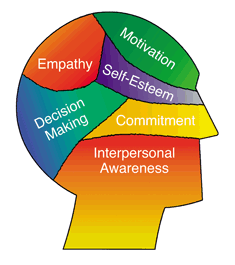
Following my recent foray into the study of Emotional Intelligence (EI), I have become acutely aware of circumstances when low EI is demonstrated. Earlier this week, a friend on Twitter shared an article highlighting a college student who was fired from an internship who reacted with verbal threats and by kicking in a glass door. The angry response demonstrated in this situation could be defined as a symptom of low Stress Management ability, one of the scales of EI.
We are not enemies, but friends. We must not be enemies. Though passion may have strained, it must not break our bonds of affection.
For their midterm assessment, our peer mentors in the first-year seminar were asked to provide a class presentation on the topic of their choice. The presentations were reviewed by our staff and also their peers in the leadership course. We completed half of the presentations last week and collected evaluations. Most were ambiguous praise such as “Great job!” and “Nice Powerpoint!”. As a preface to the presentations this week, my graduate assistant offered this gem of wisdom from Randy Pausch’s The Last Lecture.
When you are doing something badly and no one’s bothering to tell you anymore, that’s a very bad place to be. Your critics are the ones still telling you they love you and care.
I have long found Facebook to be a useful tool to link with my students. Yesterday, I was creating an ad campaign for one of my programs when an invitation to Facebook chat popped up from Austin, a student “friend”. Austin’s girlfriend was coming to town for the football game and he was shopping for an extra student ticket. I told him that I would put out the word, and then updated my Facebook status and sent an email to my student listserv.
Within a couple of minutes, I had an email from another of my Debra, thank you so much for pointing me to Danielle! Today turned out great and I owe it all to you!Thanks again.Austin
Welcome to eighteen and life. This is not a blog about Skid Row or the classic song by Rachel Bolan and Dave Sabo made famous by the vocals of Sebastian Bach. That being said, the song was an inspiration to the thought processes that you will find here. And although the original 18 and Life lyrics end tragically, my experience is that for students making the choice of post-secondary education, the age of 18 can be a stepping off point to opportunity.