Bloom’s Where You Are Planted

Spent a morning with student affairs colleagues developing new program and learning outcomes to define our work in connection to university and division strategic plans. Beginning at the bottom of Bloom’s Revised Taxonomies (below), we crafted outcomes statements to link programs and goals to unit learning domains.
Student Affairs assessment is not spontaneous. It must be intentional and carefully defined to provide meaning for your unit and for your students. If  not, it becomes just another “so what” to toss on the shelf.
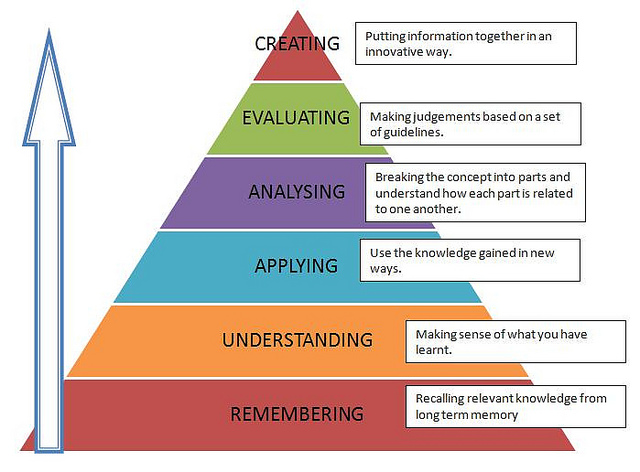
Blooms Taxonomy

Learning outcomes are all about the verbs. Check out this great list of Bloom’s Taxonomy Action Verbs.


Big Demands, High Expectations

lineinsandThat line in the sand… you know the one. That fine line between serving students and the need to separate work from personal time. The ability to decline that after-hours cell phone call or cut off the never ending stream of late night email requests that cannot wait until morning.
The expectations of millennial college students for synchronous customer service in an era of social media shaming takes a toll on student affairs professionals. Despite the satisfaction we derive from service to students, we cannot be on call 24 x 7 x 52. And yet students are only too willing to make a complaint, or worse yet, lambast our programs on Yik Yak. Where is the middle ground? Do we offer too little challenge with our abundance of support?
Don’t feel you must instantly respond to every student question and request. Sometimes it is good to encourage a student to THINK.

Price of admission

College has been on my mind lately with a high school-aged child exploring potential majors (insert major expletive or two). It would make sense that a career in higher education would contribute to some expertise in this area, but rules are complex for a high-ability student. They involve admission indexes and national scholarship competitions; areas that were not on my college search radar. Competition today is fierce. Parenting today is hard.
Why do you have to be so accomplished to get into college?

A year of accomplishments, scatterplots, new resolutions

Poor, sad, little neglected blog. I used to think that I did not have time for writing while I finished my dissertation. This year demonstrated that a preoccupied mind prevents reflection as well. I have been working on this draft for many days and struggling to verbalize the happy and not so happy of it all. Americans are supposed to be the outlier on the happy scale, more upbeat about their days than most people. When we are not in that place, it can be hard.

FT_GDP_Scatterplot

At the end of last year, I was not selected for a promotion that I fiercely wanted and had stringently prepared. It was a position I had strived for in the past, only to be discouraged from applying due to lack of a terminal degree. This “job” was not the driving force behind completing my Ph.D., but the degree was one of a series of steps that I took to prepare for a “next step” in my career. Side note, being rejected from a dream job five days before holiday vacation is not ideal for one’s self-esteem and seasonal jocularity. I recommend against it all costs.
This year began with a new boss (not getting the “job” meant working for the person who did) and the adjustments that come with a change in leadership. It also began with a new opportunity.
A position with an education non-profit came on the horizon and a new job search began. For those of us who lament the prodigious time required for campus employment, this process reached new heights. Non-profits include a scaffolding of decision makers. Whether in discussion with a screening committee, organization leaders, elected board, and the membership; each audience sought a different answer and a different set of skills. The job posted in January and concluded with a hire announcement in late September (more on this later). A colleague termed it as the job search that rivaled a pregnancy.
Meanwhile, real life work this year included financial shortfalls, intense budget negotiations, staff reorganization to address financial shortfalls, a staff member on family leave, and a staff member following a partner to new employment. Even knowing in advance, it is difficult to prepare for the transition of a dedicated colleague. Rewriting position descriptions, preparing a search committee, waiting on HR approvals, the calendar was inching along. And all of this while attending to the needs of smart and amazing students (who sometimes have tragic days) and doing my best to be a good leader and mentor for the amazing student staff and graduate assistants that I am lucky to employ. The wiser than her years, Stacy Oliver-Sikorski, recently opined “There are really awful days amidst the really great days, and we need to be more honest with ourselves and others about that.”
Facing those “awful” days and separating work from family needs was complicated this year. I am enormously grateful for a loving and supportive partner who keeps me grounded. I am happy and proud to be mom to an amazing teen and tween who are high achieving and in search of their strengths. They are my most important work every day.
I will be embarking on a new adventure in the not so distant future. Despite every obstacle, 2014 will be remembered on the happy scale as the year that I resolved to get my dream job. And succeeded.
More soon. Happy 2015!

Another year past, some same, some different

If it’s my daughter’s half-birthday, it must be another anniversary for the eighteen and life blog. It’s been a very busy year and I hope to share more about this in the next few weeks. In the meanwhile, here’s some of the cool stuff I have been reading.
Do You Possess the Right Temperament?
Why Myers-Briggs Matters
Development of the Ten Positions in the Journey Toward Self-Authorship
Please Do Not Leave a Message: Why Millennials Hate Voice Mail
Bonus: I love these MBTI Type-Head Coffee Cups!

#SAreads: Practicing Perceiving

If you are familiar with psychological type and the MBTI®, you may recognize that type theory explains the random behavior of people’s lives as actually quite orderly and patterned. This is due to basic methods used by individuals to take in information and make decisions.
The last letter of the 4-letter MBTI code highlights the process one uses in dealing with the outer world. Do you prefer to plan ahead and get things decided (Judging) or do you prefer to remain flexible and open to new options (Perceiving)? Not to be confused with organization, as either preference can be organized, the J or P Preference indicates how we interact in our outer life, whether structured and decided (J) or curious and open-ended (P).
Which option would you choose?
Do you prefer to:
  1. Arrange lunch plans, events, parties, etc., well in advance, or
  2. Be free to spend your day doing whatever looks like fun?
In Building Momentum: The Unconventional Strengths of Perceiving College Students, Meri Beckham explores the successful practices of Perceiving college students including unconstrained time and working at the last minute. These methods are cited as the opposite of ideal strategies promoted in college success and study skills texts.
If you work in academic success, retention, first-year programming, or are interested in helping students make effective transitions to college, grab the article and join us Friday at 1PM EST for this week’s discussion on #SAreads.

Senior Night

Senior night in high school sports is a time to recognize graduating students and their accomplishments. At the pre-game celebration for our local girls soccer team, players were honored with a bouquet of flowers while escorted to center field by their parents. Honors and activities are announced for each player, culminating with where they will be attending college in the fall. It was no surprise that each player from our academically ranked high school was heading to a four-year institution including several research universities and prestigious private colleges.
Fast-forward a week to an opportunity to attend another senior night, in a small town 40 miles from our small university city. Only this time as each player is introduced, the future plans are predominantly for community college. Only two of the twenty players were planning to attend a 4-year college or university. And 17 of the twenty players were Latina.
Why the difference? Demographics and privilege are most certainly a factor. Our small city is 85% White with 3% of persons identifying as Hispanic or Latino/a compared to a town where 35% of the population is Hispanic or Latino/a. The Latino population has grown dramatically in the town over the last decade with the addition of a new meat packing plant. These backbreaking low-wage jobs are attractive steady work for the mostly of Mexican-origin immigrants moving into Iowa.
College enrollment of U.S. Hispanic students surpassed that of White students for the first time in 2012. In contrast, the number of Hispanics completing four-year degrees only accounted for 9% of young adults. Hispanic students continue to be less likely to enroll in a four-year college or attend college full-time.
Our university student success committee has spent significant discussion time on Who Gets to Graduate? While formulating models for student persistence, we review many variables involved in graduating the students on our campus where Hispanic and Latino/a students make up the largest non-majority population. Our students of all ethnicities are academically motivated, but are frequently working class and first-generation, which sometimes translates to not being prepared for the rigor of higher education at a research university.
So the question becomes not only who gets to graduate, but also who gets to enroll?

The Rise of the College Graduate

mortar_board
In case there is still debate over the value of a college degree, the Pew Research Center is trying to put the argument to rest, once and for all, with a new report The Rising Cost of Not Going to College. Most convincing is the finding that when compared with previous generations, there is even more income disparity between college graduates and those with a high school diploma.
For those who question the value of college in this era of soaring student debt and high unemployment, the attitudes and experiences of today’s young adults—members of the so-called Millennial generation—provide a compelling answer. On virtually every measure of economic well-being and career attainment—from personal earnings to job satisfaction to the share employed full time—young college graduates are outperforming their peers with less education.    ~Pew Research Center

The Great Debate continues…

The president of Georgia Regents University renewed discussion on the value of a college education with his recent essay, The Great Debate: Is College Still Worth It?  The piece included poll results from a new survey by the American Association of State College and Universities stating that those with a college education and those more likely to benefit from higher education believe in its worth. So, college graduates, women, and communities of color have buy in to the value of education.
…to ensure our collective future success, more Americans must appreciate the value of, have access to, be able to afford, and complete college. This message must be disseminated widely, so we can rally the will and resources necessary to make it happen.  ~Dr. Ricardo Azziz
More on the Value of Higher Education:
Why College is Still Worth It
Choose Education
Education Value
Future Earnings

Making Meaning with Type in College Student Affairs

Screen Shot 2014-01-03 at 10.58.25 PM

If you enjoyed my post on the MBTI Type preference of student affairs practitioners, you may be interested in this expanded article recently published in the Bulletin of Psychological Type, a publication of the Association for Psychological Type, International.
Link to article: Making Meaning with Type in College Student Affairs